Developing Math Models
For this second math log, my focus will be on the question: why might it be beneficial to spend time developing and working with mathematical models (e.g. the number line, open array, etc.)? What do these models help students to do? How could you construct a particular model with a P/J class?
Developing and working with mathematical models such as the number line or the open array, allow students to begin decomposing and composing numbers that make sense to them. Students have the opportunity to use alternative algorithms to solve problems. Compared to traditional algorithms that limit students’ thinking and understanding. Traditional algorithms have been said to actually be harmful to students because they lose conceptual knowledge (Kamii and Dominick 1998).
The Open Array
The first model or alternative algorithm that I will be discussing is an open array. It is a semi-concrete representation that involves the use of the distributive property to create a rectangular model with partial products in each section (Van de Walle, 2018). Using models helps students understand that numbers can be broken up in many ways to make computation easier (Van de Walle, 2018). For instance, if students are presented with the equation, 15 x 20, it might seem daunting until mathematical models are introduced. If students know that they can break the number up (decomposing) and set it up as 10 x 5 x 10 x 10 in an open array, then the problem isn’t nearly as big anymore. The textbook refers to this as breaking down numbers into easier-to-handle parts (Van de Walle, 2018). Students are able to break down bigger multiplication problems in a way that becomes more efficient and encourages students to use mental math to solve the problem instead of using traditional algorithms (Van de Walle, 2018). In class we have used open array models to represent our own thinking and also to understand how students might use them. In class, we were given multiplication problems and everyone was encouraged to solve them using an alternative algorithm. After this we did a gallery walk to see the different ways that people decomposed the numbers to make it easier. Open arrays are a great tool for these types of multiplication problems. They make more sense to students because place value and carrying doesn’t become confusing like it does with the traditional method, and students are given the option to add up the partial products in any order they want that is easiest for them (Van de Walle, 2018). According to Carroll and Porter, most students do not come up with alternative algorithms for multiplication on their own, like they would with addition and subtraction (Carroll and Porter 1998). Therefore, it would be even more important and necessary to construct these models in our classes. Below is an example of using the open array model to multiply 26 x 7.
The Open Number Line Model
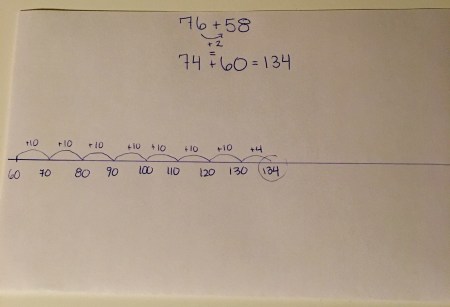
Next, A number line model is a tool that helps students with counting on and counting back with addition and subtraction (Van de Walle, 2018). In class we often use open number lines to represent students’ thinking on our mini whiteboards. It’s an easy model that shows how students solve math problems. Using an open number line allows students to try different strategies for adding and subtracting, such as adding tens and then the ones, or moving numbers to make tens so that adding on the number line is easier. For example, if a student is adding 76 + 58, they could transfer a 2 from the 76 and make 60 instead of 58, then the student would have 74 + 60, which can be easier to add, especially if students are dealing with bigger numbers (Van de Walle, 2018). The same applies for subtraction. From learning to use strategies on the number line to add and subtract, students are able to develop “powerful and flexible strategies” that will be beneficial to them in the future when they are working with more complex problems (Van de Walle, 2018). Using number lines is also another model that helps students understand the distributive property and how numbers can be broken up and then put back together in the end. Students often invent their own strategies for solving problems, and as discussed in the textbook, a great way to represent students’ thinking is by using an open number line so students can see how to visually break apart the numbers (Van de Walle, 2018). When I worked as a tutor in the classroom, the teacher always had number talks during math, and she would represent students’ thinking with different models on the whiteboard, mostly number lines. When I am in placement I will keep this in mind so that I remember to construct these models with my class.
Thoughts…
I was wondering at first how might teachers go about teaching these models to students who aren’t used to them and like me, grew up with traditional algorithms. Then I thought of myself, and how I quickly learned and loved alternative algorithms because they just made so much more sense. It takes some time to develop that shift in thinking, but once it happens it’s worth it. These models have been extremely helpful for me, and have helped me strengthen my number fluency.
References
B. (2013, January 22). Retrieved November 08, 2018, from https://www.youtube.com/watch?v=qdYV6i-kXcA
Carroll, W. M., & Porter, D. (1998). Alternative algorithms for whole-number operations. Yearbook (National Council of Teachers of Mathematics), 106–114. Retrieved from https://ezproxy.lakeheadu.ca/login?url=http://search.ebscohost.com/login.aspx?direct=true&db=eue&AN=507609813&site=eds-live&scope=site
Van de Walle, J.A. (2018) Elementary and Middle School Mathematics. Ontario, Canada: Pearson.
 Ms. Cerullo's Teaching Tales