Over the past few weeks I’ve had the amazing opportunity to work as an intern at the Orillia Public Library for Coding with Robots. The children, as well as myself, have learned so much about coding, and the ways robots can be incorporated in the classroom. There were some children that already knew so much who were excited to keep learning, and others that had little experience. After the four weeks, all of the students were picking up on everything so quickly .Go, Path, Blockly, and Wonder, were the four different apps that we used, each one is a little harder than the last. From this, I’ve taken away very valuable skills and information that I never would have stumbled upon by myself, that will be beneficial to me in my teaching career. With this new knowledge and experience, I will potentially be able to introduce coding to my students and teach them these new skills that they can carry with them in life.
Computational thinking is a hot topic today. Computational thinking can be defined as an efficient way of solving problems. It is a way of thinking that can be taught to students involving the four steps of: decomposition, pattern recognition, abstraction, and algorithm design (n.d). Hearing these steps might make someone wonder how and why computational thinking would be taught and used in a classroom because these words sound like they should only be used with computers. However, this is not the case. Research explains how applying computational thinking in our daily lives in the classroom can help students solve problems efficiently (What is Computational Thinking?). Learning to code with robots teaches these problem-solving skills to students. For example, teaching algorithms doesn’t have to be confined to computing, it can be applied to the curriculum and all subject areas to better solve problems. This is such an interesting topic of discussion, and there is so much more to learn.
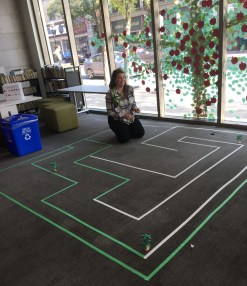
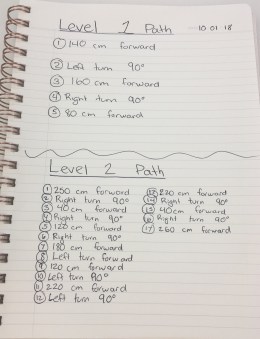
In the picture of the measurements below for the level 1 and 2 paths, Ms. McCulloch and I measured the distance in the path that the robots needed to travel. The students used measurement, angles, and sequencing when estimating the distance they would need to code their robot to move. There are so many different kinds of activities students can do with coding robots that can be connected to the curriculum in subjects such as math, science, music, language, drama, and the list goes on. It is a fun and interactive way to have students working as a team collaborating, communicating, problem-solving, and developing life skills in the classroom with their peers.
One Ontario educator who is known for promoting coding in the classroom is Brian Aspinall. Aspinall’s website is full of many great resources that can help teachers with coding and lesson plan ideas. An example on his blog is teaching geometry using robots and coding. He explains how this lesson would involve communicating, problem-solving, and representing, all of which the Sphero Ball is involved with. His website is very helpful to future teachers.
Laura Collins is a teacher who shares some experiences she has had with coding with robots, and how they have enriched students’ learning in the classroom. Collins has found that the best way for her to close achievement gaps is by providing her students with exceptionalities hands-on, STEAM experiences. In this very recent article she provides extra coding resources, along with her scaffolded approach to teaching.
The video below is a short clip that I took of the robot Dash, playing “Twinkle Twinkle Little Star” on the xylophone. Using the Xylo App on a smart device, children were able to program the robots to play new or pre-programmed songs of their choice. The possibilities are endless and there is so much to explore.
References
Aspinall, B. (2015, April 29). Exploring Geometry by Coding. Retrieved from http://brianaspinall.com/exploring-geometry-by-coding-with-gosphero-tickleapp/
Collins, L. (2018, September 27). Coding & Computational Thinking in the Classroom. Retrieved from https://www.teachontario.ca/community/explore/coding-in-ontario-classrooms/blog/2018/09/27/robots-in-primary-school
What is Computational Thinking? Retrieved from https://computationalthinkingcourse.withgoogle.com/unit
(n.d).Introduction to computational thinking. Retrieved from https://www.bbc.com/bitesize/guides/zp92mp3/revision/1
 Ms. Cerullo's Teaching Tales
Hi Sam, I loved reading your post about coding with robots as this is something I have never done and did not have a chance to do when they brought them to the class. I find it very helpful that you added the apps you used to learn about how to code these robots. I especially liked that I had the chance to view the video you took of the robot playing the xylophone, that was really cool! You mentioned that these robots can be connected to many different curriculum subjects, so I was wondering how you might incorporate these robots into a language lesson? Thanks so much for sharing this amazing information with us! I definitely hope to look further into using technology like this in the classroom.
LikeLiked by 1 person